Model comparisons
GPT-5.6 Sol vs Terra vs Luna: Which Model Fits?
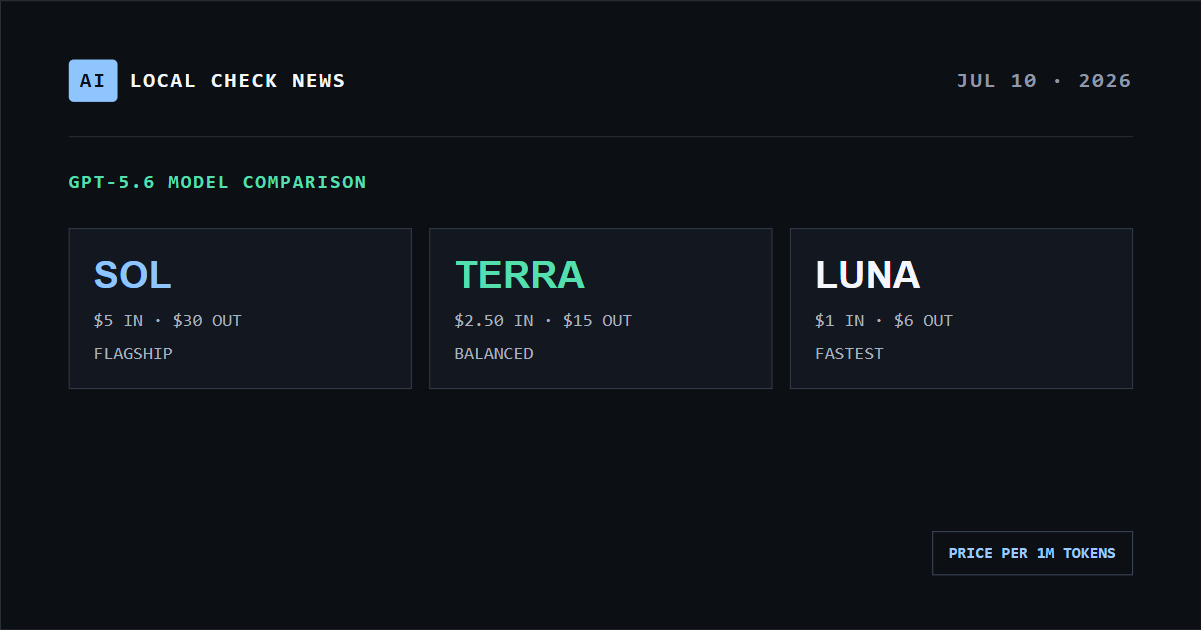
OpenAI's GPT-5.6 family reached general availability on July 9, 2026 with three tiers: Sol, Terra and Luna. They share a generation number, but differ in price, positioning and access to the highest-compute modes. This comparison separates those product differences from claims that cannot yet be independently verified.
Sol, Terra and Luna at a glance
OpenAI describes the names as durable capability tiers rather than temporary model suffixes. Sol is the flagship, Terra is the balanced tier, and Luna is the fastest and most affordable. The official GPT-5.6 launch article says all three are available in ChatGPT, Codex and the OpenAI API, with access depending on plan and product.
| Tier | Input / 1M tokens | Output / 1M tokens | Primary positioning |
|---|---|---|---|
| GPT-5.6 Sol | $5 | $30 | Highest-capability flagship |
| GPT-5.6 Terra | $2.50 | $15 | Balanced everyday work |
| GPT-5.6 Luna | $1 | $6 | Fastest, lowest cost |
At standard API rates, Sol costs twice as much as Terra and five times as much as Luna for both input and output. That does not mean a completed task always costs exactly two or five times more: models may use different numbers of tokens, reasoning effort changes consumption, and multi-agent execution adds work.
GPT-5.6 Sol: when capability is the priority
Sol is the tier OpenAI positions for its most demanding coding, knowledge-work, science, cybersecurity and computer-use workloads. It is also the model associated with the highest reasoning settings.
max gives the model more time to explore alternatives and check its work. ultra coordinates four agents in parallel by default, according to OpenAI. Ultra can reduce elapsed time on complex work, but parallel agents can increase total token usage. Teams should compare successful-task cost, not only the price printed per million tokens.
GPT-5.6 Terra: the balanced tier
Terra is priced at half of Sol and is presented as competitive with GPT-5.5 for everyday work. That makes it the logical starting point for production tasks where Sol's additional capability may not change the outcome: structured extraction, routine analysis, drafting, support workflows and many coding tasks.
The correct evaluation is workload-specific. A cheaper model that requires repeated retries can cost more than a stronger one, while using Sol for predictable high-volume tasks may waste budget. A representative test set should measure accuracy, completion rate, latency and total tokens.
GPT-5.6 Luna: throughput and cost
Luna is the lowest-priced member of the family at $1 input and $6 output per million tokens. OpenAI positions it as the fastest tier. It is therefore the most obvious candidate for latency-sensitive or high-volume operations where the task is constrained and errors can be detected.
Examples may include classification, routing, formatting, lightweight extraction and first-pass processing. These are potential workload categories, not guarantees: the launch article does not publish a universal rule defining which tasks Luna can complete reliably.
Availability differs by product
OpenAI says GPT-5.6 is rolling out across ChatGPT, ChatGPT Work, Codex and the API. Plus, Pro, Business and Enterprise users can access Sol through medium and higher effort settings in ChatGPT. Pro and Enterprise users can also select Sol Pro for the highest-quality results on complex tasks.
In ChatGPT Work and Codex, eligible users can choose among Sol, Terra and Luna. Access to max and ultra depends on the product and plan. Developers can call all three tiers through the API.
Prompt caching changes the cost calculation
For GPT-5.6 and later models, OpenAI states that cache writes are billed at 1.25 times the normal uncached input rate. Cache reads retain a 90% discount, and the family introduces explicit cache breakpoints with a minimum cache life of 30 minutes.
Applications with large repeated prefixes may benefit substantially from cache reads, while frequently changing prompts may pay more for cache creation without enough reuse. Cost projections should separate uncached input, cache writes, cache reads and generated output.
Which GPT-5.6 model should you choose?
| If your priority is... | Start testing with | Reason |
|---|---|---|
| Maximum capability on difficult tasks | Sol | Flagship tier with max and ultra options |
| Balanced quality and API cost | Terra | Half Sol's standard token price |
| Low latency or high-volume simple work | Luna | Lowest standard price and fastest positioning |
| Offline or private on-device inference | None | No downloadable weights were announced |
The recommendation is a starting hypothesis, not a benchmark result. Test the same tasks on all relevant tiers and calculate cost per accepted output.
Can any GPT-5.6 tier run locally?
No official local release exists for Sol, Terra or Luna. OpenAI announced hosted product and API access, not model weights, parameter counts or GGUF files. A desktop client that sends requests to the OpenAI API remains a cloud client.
Because the underlying files are unavailable, AI Local Check cannot calculate real weight sizes, quantization choices or VRAM requirements for these models. For the local question specifically, see our GPT-5.6 Sol local-availability analysis.
Bottom line
Sol, Terra and Luna are best understood as capability and cost tiers inside the same hosted generation. Sol targets the hardest work, Terra offers a middle ground at half Sol's token price, and Luna minimizes price and emphasizes speed. The right choice depends on completion quality and total workload cost — and none is a substitute for an open-weight model when offline inference is required.
Primary sources
- OpenAI: GPT-5.6 general availability — July 9, 2026.
- OpenAI: Previewing GPT-5.6 Sol — June 26, 2026.